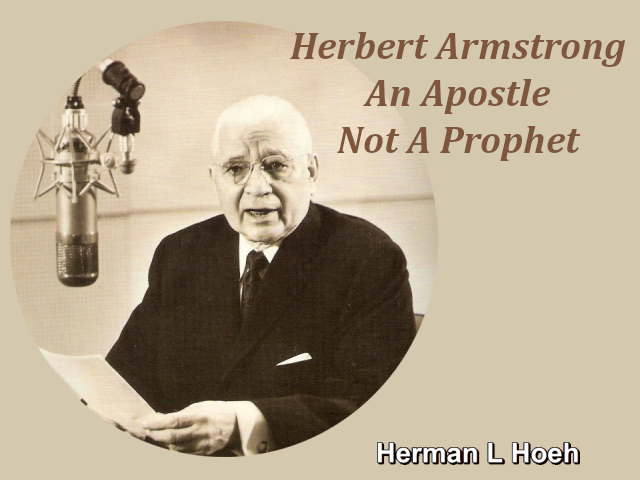






Herbert Armstrong An Apostle Not A Prophet

Today, I would like to discuss a topic that I have had to answer on more than one occasion recently. It ought not to be a fundamental topic, but indeed, it can become one for some. And therefore, I think it would be good for us to be able to answer the question of others, which we're going to have to answer over a significant period of time.
The question is simply put, and although others have given it, I'm giving it specifically from a certain perspective. I believe Mr. Ronald Dart has covered this subject also, and other congregations from his perspective as well. The subject is: How do you explain Mr. Armstrong's authority since what he said didn't come to pass when he said it would? And I think we should be able to look at that question and to understand it better than some do.
And we might remember a few things from the sermonette in this connection. The passage which is usually first cited is that of Deuteronomy, chapter 18. We will turn to it first so that you know what provokes the question, and then we'll take a look at some illustrations, some answers. Deuteronomy 18:20, 22 follows the fact that there should come a time when God would raise up a prophet from among the children of Israel, who is understood in the Christian community to be Jesus Christ. Verse 20, however, is what we want to focus on:
"But the prophet which shall presume to speak a word in my name, which I have not commanded him to speak, or who shall speak in the name of other gods, even that prophet shall die. And if you say in your heart, 'How shall we know the word which the Lord has not spoken?'—in contrast to what he has spoken—when the prophet speaks in the name of the Lord, if the thing follows not, nor comes to pass, that is the thing which the Lord has not spoken, but the prophet has spoken it presumptuously; you shall not be afraid of him."
Now, about four years and more ago, a number of individuals made reference to certain things which the church had published in the 1950s or 1960s as to what and or when certain things should occur. I think we should squarely face some of the questions that have been raised and understand the relationship of this work, even to some of these verses such as given here.
And now, we are told that there are those who speak in the name of false gods or those who have other authority than the church of God. I will pass over that since that is not the issue. But what about those who speak in my name in this sense? Are we dealing with a case where the church has officially, at its highest level, spoken presumptuously? And that will it or will it not come to pass is the question that has entered the minds of a number of people.
I would like also to turn over to a related verse that is not normally cited. Well, it's a related chapter—the whole of the 13th chapter of Deuteronomy:
"If there rise among you a prophet or a dreamer of dreams, and he gives you a sign or a wonder, and if the sign or wonder comes to pass while at the same time he says, 'Let's go after other gods that you haven't known; let us serve them,' you are not to hearken to the words of that prophet or the dreamer of dreams. For the Lord is proving you to know whether you love Him with all your heart and with all your soul, for you to walk after the Lord your God and fear him and keep his commandments and obey his voice, and you shall serve him and cleave to him."
Now, what is important to note is that there are those who appear as prophets and what they say comes to pass. But at the same time, you are being tested by the fact that the time they say certain things you were asked to also to reject the law of God, no longer to keep His commandments and obey His voice.
So, what is critically important here is the recognition that the ultimate test is whether the individual speaks according—shall we say—to the law and to the prophets. Moses is here giving a specific reference to the law of God, to His commandments, and to those things which He has spoken with His own voice. When an individual comes along with a message that is contrast, even though that individual may have unique powers or gifts in other manners, one must draw the conclusion that however real the miracle may be, however true an advance pronouncement may be, you are not to give heed to the rest of what they say when they go contrary to the intent of the law of God.
All right, now we will turn this around in terms of Deuteronomy 18. There is no question that there have been individuals who have warned of certain things and who have also spoken contrary to the law of God and its intent and purpose. God did raise up the Radio Church of God, the Worldwide Church of God of corporate names, to do a work. But let's say that we are dealing here with the continuity of that body of believers called the Churches of God. We can go back to the last century. We can think of it in terms of the 1910s and 1920s or the work that specifically developed from Eugene, Oregon, in the 1930s and 40s and continued to emanate from Southern California here in the late 40s, and 50s, 60s, and 70s.
In this state, the Church of God has always, in all fundamentals, spoken in terms of what God's law and His commandments tell us, and that pertains to human character. In other words, we have, as a body of people, spoken in terms of what a man ought to be like. And here, I think you should reflect on a number of those things.
Mr. Philip, called the horse lover, has stolen. You're not to be like horses, but note that you are to be governed by the law of God after the inward man, where you finally acquire the character and the thinking of God, know what it means to become like God, to be perfect as your Father in heaven is perfect, and to obey the commandments. We are really looking at the law which defines human character. And unfortunately, there are those who have gotten away from the understanding that the law of God is a simple outline in defining human character.
Now, there may be ministers in the church who were asked to preach, and Mr. Armstrong was asked to preach and to speak. And he explained the law of God certainly in greater understanding than the Churches of God, Seventh Day, had in the early 1930s, and much of the law that was being neglected was brought to the attention of the brethren. And so, there can be no question as to what is required in the Bible and in our practice as a church.
Was Mr. Armstrong, when he first spoke or at some later time, called to an office in which he had visions and dreams? As you find, for instance, in the beginning of chapter 13—a man who has dreams or a man who has visions and performs signs and wonders of that nature. Now, some of the brethren in the late 1940s always referred to Mr. Armstrong as a prophet. I did speak plainly to them up there, and Mr. Armstrong never did deny the fact of what I was saying: that God had not called him to be a prophet. Now, I said that while I was still a student in college, and I would say the same thing today. I know of no case up to the present where God purposefully showed him in signs and wonders, and dreams, or any manner in which normally the prophets of old received special messages. I don't know of any case where this is characteristic of how God revealed any matter to Mr. Herbert W. Armstrong.
Now there were some prophets in the New Testament church, and I use that term not as Paul sometimes did in terms of one who preaches. God did open however, Mr. Armstrong's mind, in studying the Bible to no small number of basic prophecies that he was asked to seek out and to clarify those basic prophecies. And there is no doubt in my mind—and I have gone over carefully to try to explain to you last year some of the fundamental prophecies of Daniel chapter 2 and 7, Revelation 13 and 17, and then there are some related chapters to these particular ones.
This is the framework of history, the framework of prophecy, if you please. They were revealed to individuals in times past, and the explanation, broadly speaking, was understood in the Churches of God, Seventh Day, and in the Sabbatarian Churches of God even earlier. Now, most of you do not know, unless you have seen such a piece of literature, for instance, that it is a basic tradition that the explanation which Mr. Armstrong has given to the Book of Revelation—of the seals and of the trumpets and the seven last plagues in the same order that we have in the booklet on the Book of Revelation—may be found in the literature of the Seventh Day Baptists, who are descendants of Sabbatarian who broke away from the Churches of God tradition by the early part of the 19th century.
So, there is little doubt that broadly speaking, there has been a general understanding of the outline of prophecy in the groups of people who have, from time to time, made up Sabbath-keeping groups. The Churches of God, Seventh Day, seem in some cases even to have lost certain things preserved among the Seventh Day Baptists, which you may discover in some of their literature, and sometimes it was vice versa.
So, we at least recognize that in principle, the church and the ministry taught certain broad things pertaining to prophecy at the end of the last century. At the beginning of this century, in the Churches of God, Seventh Day, there arose a number of people who began to understand the identity of the lost tribes of the house of Israel. This was never the official teaching of the Church of God, Seventh Day, and Mr. Armstrong did come to an understanding, broadly speaking, of the distinction between the birthright and the scepter promise.
So, what we have therefore is some added information and some clarification on some of the broad things of prophecy. But when someone in the Church of God studies the Bible and studies prophecy, I think you must understand that in the light in which Peter speaks, in which he said, "Listen carefully, that the light of prophecy shines in a dark place more and more," so that there are things which become clearer than initially.
But when one studies prophecy, there is always the possibility that what you think you see clearly, because of the weakness of the light or the inability of your eyes to see, becomes clearer later in your understanding is expounded more and more with study. So, we must distinguish between a message which is claimed to be a direct revelation from God and the nature of the study of prophecy and law and any other part of the Bible. And specifically, with respect to prophecy, the fact is that the more one studies, the more likely one has a better understanding, and therefore the need for clarifying some things that would be said earlier.
I want to make this clear so that you grasp yourself how you study the Bible and how the church is to study the Bible. Mr. Armstrong came at a time to an understanding of a lot of broad outlines in prophecy when the Churches of God and the whole world, for that matter, were in the depths of what we call the Great Depression. That was before the government learned that they could stay in power longer by meddling in the economy for good or evil.
And so since then, instead of letting business cycles take their course, we now have governments that would be able, in fact, to prevent a Great Depression in the manner in which it happened before. Bear this in mind, knowing the poverty of many people in the 1930s, and what we might call the financial trials and tribulations of the nation, the whole Western world. Mr. Armstrong first assumed that when the word "tribulation" were used, it pertained to the economic crisis through which the world was passing in the midst of the 1930s.
I am not persuaded that all of you would have drawn other conclusions because there was no religious persecution except incidentally. Even though it might have been a little difficult to keep the Sabbath or to take out the Christmas tree from the home, a few things like that, as one would look at it, there is no doubt that the trial was an economic trial such as no generation in the modern world had ever experienced. This led, if you please, to the rise of militarism in Japan, the rise of Adolf Hitler and his 12 apostles, if you please, who followed him in the Nazi hierarchy who wanted to establish the 1000-year Reich to deliver Germany from the tribulation and later the Jews into it.
It gave rise to Benito Mussolini and the rebirth of the Roman Empire. It gave rise, if you please, to the New Deal in the United States and all the consequent deals we have been given. It gave rise ultimately to the crisis that we call the II World War.
Now, when Mr. Armstrong first studied prophecy, he saw the possibility that there were 2,520 years between 604 B.C. and 1917 A.D. This was not original with him, but he saw certain things of the 1917 date pertains to the acquisition of Jerusalem on December 9th, as you remember, when Allenby received the surrender of the Turkish governor of the city.
So we have known a man whose name is one that you have seen with some photographs that we have pictured from the Middle East. This gentleman of Danish descent was in Jerusalem in 1917. To my knowledge, he is the only one who was there, and he still may be living—I haven't kept up to date, but as of the latest, at least, he was alive here. Mr. Eric Mason has pictures, and we are in possession of the pictures of the surrender of Jerusalem in 1917, with the Turkish governor holding the white flag, and then the attempt a few days later of the Turks to retake the city and the dead bodies of the Turks who fell in the abortive attempt to do so.
In any case, Mr. Armstrong saw some things in Leviticus chapter 20… Now, let me turn to the chapter just to have it here. The "seven times" there mentioned in the account here. The story of the blessings and the curses are laid out—blessings for obedience and the curses for disobedience—all that is given here in Leviticus 26. The British-Israel World Federation and many people were studying the Bible, and it was thought that there should be some connection between 604 and 1917. There were other people who thought it was 607 and 1914, hence the Jehovah's Witnesses, as they were later called, or the International Bible Students, drew that conclusion. Because there was no time that they could settle on as to the fall of Jerusalem to the Babylonians, and so there was no clear understanding of when it would be over.
But those who took, nineteen, sorry, those that took 604 B.C. and came up to 1917 also tended to take 585 and came to 1936. Now, 585 was, for a long time in the church, understood to be the fall of Jerusalem in the 11th year of King Zedekiah, and there was a 19-year period between the first acquisition of the city and the fall of Jerusalem. And so, it was thought that the world was headed into a great tribulation that was to take place somewhere, let's say, beginning in 1936. Because it was thought that after a certain period of time, that you would have, in other words, a crisis that would bring in the "quote of things."
Now, to us today, the 1930s might seem irrelevant, but to those who lived there and wondered how to understand the seven times or 2,520 years, wondered how to understand the storm clouds of war that were breaking over Europe, it is not illogical to see that after supposedly the economic crisis was improving, it was headed in a decline again—it was getting worse, despite the New Deal in 1937.
Now, Mr. Armstrong came later to realize that the 2,520 years had nothing to do with what was thought to be, you see, a period of time to the "clo ending" to the close of the 1930s in which it was thought that the times of the Gentiles would now be ultimately fulfilled. At that time, it was generally assumed that the times of the Gentiles somehow ran parallel with the punishments that came on Judah, and after 2,520 years, the Gentiles would bring on a great tribulation, and there would be war, and the day of the Lord, and the crisis of the "quote."
Now, that's as much as any people, in or out of the Church of God, understood prophecy. Mr. Armstrong, in the late 1940s, by probably 1945 or 6, published a little Bible study pamphlet that they used to use in Eugene, Oregon, in which some of these things were clarified, and some things he had to clarify later.
So, what we learn is that in Mr. Armstrong's office, as it was clearly doing an evangelical work or the work of an evangelist, he studied the prophecies and he found some things that he had first thought to be an explanation—he found them to be incorrect. Now, there is one thing that was fundamental to the work of the church and always should be: that when we find we do not fully understand certain prophecies, or any other parts of the Bible, and when we find that we better understand them, then we correct our understanding.
And Mr. Armstrong did correct the understanding and saw that the times of the Gentiles were another matter altogether and were not to be reckoned from the fall of Judah. I do not believe that even our later understanding—and my later understanding—of the times of the Gentiles has been correct. That indeed, a 2,520-year period based on Daniel chapter 4 is to be seen not as bringing the close of Gentile dominions, but as, in fact, being a period of time before which the rise to prominence in the latter days of the Gentiles will not even occur.
Hence, the reference to 1982, which is 2,520 years from the fall of Babylon, which seems clearly to be the premise that would indicate that any ultimate final Babylon wouldn't arise until after that time has occurred. That was 539 B.C., remember, when Cyrus and the Medo-Persians took over Babylon.
But what we learned is that when Mr. Armstrong saw that the Holy Roman Empire was being reestablished—I want to correct that statement: when he saw the Roman Empire being established by Mussolini—he wasn't clear in terms of how to understand the two parts of the system. Remember in Daniel 2, there were always two legs. And he wondered whether Mussolini was to be followed by Hitler or whether it was to be a kind of axis. And as it turned out, there is no doubt it was a kind of axis. That is like the left foot and the right foot, the Italians represented one part of the realm, and they created an empire of the Roman Empire in the Mediterranean, which occupied Libya, parts of Egypt, Eritrea, and then Ethiopia, Italian Somaliland. They got Albania, the countries that seemed at that day critically important to us.
Many of these countries are of no consequence at all, but these were critical areas into which the Italian states created by Mussolini expanded. And north of the Alps, where the barbarians lived, there was now the founding of the Third Reich, like another branch, and it was all over. And now, Mr. Armstrong, instead of discovering a tribulation and the day of the Lord, discovered a whole new phase of God's work—that is, there were things to be done in the church that never had occurred to him that he would be used in doing before.
I think for some of you who were born 20 years after this, and most of you, never even if you were older are old enough, most of you never even heard the broadcast at this time or how one would have thought if you were studying the Bible in terms of events. So, Mr. Armstrong realized that the day of the Lord was yet to come in the future. How far into the future was unclear, but it was not long in coming that we discovered that a prostrate Europe was going to rise again because there had not been seven revivals of the Roman Empire.
Mr. Armstrong saw that right away when Winston Churchill stepped on the world scene and said there should be a united Europe. The Americans had a Marshall Plan, and in the terrible struggle of the late 1940s and early 50s between the United States and the Soviet Union for the political minds and the economic minds of Europe or Europeans, the Russians came to solidify what we now know as the Iron Curtain. And Western Europe began to take economic shape as the European Coal and Steel Community and finally the Six of the Common Market, and it's now nine.
And so, we saw what was beginning to take shape. And I think we can say that the time frame is what we did not perceive clearly. But I want you to note that when studying the Bible in terms of prophecy, it is the time frame indeed that Mr. Armstrong did not speak clearly, or any of us in those days. Nor, for that matter, even did Jesus' apostles see the time frame clearly.
I would like to quote you some miscomprehensions of prophecy by the apostles of Jesus Christ, just so you understand that what is to come to pass, and the world may be warned about what is to come to pass, may be seen even by Jesus' apostles in a timeframe that is incorrect.
The apostles had asked Jesus on many occasions, "Well, when should we expect all this?" And in 31 A.D., this is A.D. 31, certain miracles happened on the day of Pentecost. And Peter stood up in chapter 2 with the eleven and lifted up his voice and said to the people:
"You men of Judea and all who dwell in Jerusalem, let me explain that what you see here in the appearance of the Holy Spirit or tongues of fire is not a reflection of men who are drunken, but it is what was spoken by Joel the prophet. Verse 17: Joel the prophet says, 'It shall come to pass in the last days,' says God, 'that I will pour out my Spirit upon all flesh, and your sons and your daughters shall prophesy, and your young men shall see visions, and your old men shall dream dreams. And on my servants and on my handmaidens, I will pour out in those days of my Spirit, and they shall prophesy. And I will show wonders in heaven above and in the earth signs beneath, blood and fire and vapor of smoke. The sun shall be turned into darkness and the moon into blood before the great and notable day of the Lord comes when God, of course, was to intervene and set up his government, which is what the apostles had been interested in. And it shall come to pass then that whosoever shall call in the name of the Lord shall be saved.'"
Now you men of Israel hear these words and now he points out that Jesus of Nazareth was a worker of miracles and God raised him ultimately from the dead. And David spoke of the presence of this person who would be none other of course, than the prophet of whom Moses spoke. We would of course have descended from David. He is now at the right hand of God and the Lord has asked him to sit at his right hand in heaven until he makes his foes his footstool verse 35. And so we shall know that all the house of Israel and it shall know that God has made the same Jesus whom you were involved in crucifying both Lord and Messiah.
Now, as far as they were concerned, when the Messiah was to come, he was also to deliver the people at that time from Rome. This was the way it was viewed. And so, Peter, quoting Joel, had no doubt in his mind that the beginning of the pouring out of the Spirit of God on the church on the day of Pentecost was the beginning event that would lead to heavenly signs preceding the day of the Lord and the intervention of Jesus Christ, who was briefly at the right hand of God til God placed him on the throne of David.
And, to say that these men had any conception of having to wait to the second century, or the third, or the 13th, or the 19th, or the 20th, is to misunderstand what Peter was saying when he was quoting Joel. They did not know the time. But what they did know was that these things would come to pass. And here is an apostle, as Mr. Armstrong came to be used in the church, quoting things far before their time. So that If you please, those people living at that time who later died and who will not come up in a resurrection til long after those events are fulfilled, will themselves be able to remember that Peter told them God would intervene, and by the time they come up in the resurrection, he will have intervened 1,000 years before they appear in life again.
Now God could have said that there's no reason for my apostles to show that I will intervene because it isn't going to happen in their day anyway, and the people who would have lived in that time would have had no warning that it would take place. But God chose not only to make the warning known, he also chose to let it appear that the very men who said it were mistaken because when they thought it should occur, it did not.
You come to the 60s A.D., and you remember the story of the Roman armies in Jerusalem from 66 to 70. It would be very unlikely if you were to read the words of Jesus in Matthew 24 and its parallels in Mark and Luke, that you would have come up with any other conclusion than that the crisis of the close was at hand. It would be very difficult not to have come to that conclusion, based even on the fact that Jesus said that this generation shall not pass until all these things be fulfilled. What was not understood was that Jesus was referring to a final period when all these things shall occur, and of course, they were all fulfilled briefly up to a certain point only in that generation.
But let me look at a few verses here. Let's take some of Paul's statements. I will turn to Hebrews and see how Paul the Apostle of Jesus Christ looked at some of these things. The book Hebrews 10:35-39: [inaudible].
"Do not cast away your confidence. This is apparently written in the earlier 60s A.D., which has great recompense of reward, for you have need of patience," as Mr. Philip brought out, "that after you have done the will of God, you receive the promise. For yet a little while, and he that shall come will come." In other words, don't assume that if you die before Christ comes, you won't get a reward. So, "For yet a little while, that's all," apparently Paul knew in the early 60s, "and he who will come will come and will not be late. But in the meantime, we're just going to have to live by faith." That's quoted from a very interesting chapter in the Old Testament. "But if any man draw back, and assume that our statements of prophecy about the return of Christ, and I hope that he should return in this generation—if he should draw back, because Christ doesn't appear to return in this generation," says Paul, "my soul shall have no pleasure in him. For we are not of those who draw back into perdition and who abandon the law, who assume that if Mr. Armstrong did not understand the time of prophecy, he couldn't have understood anything." He said, "We must not be like those who therefore neglect the law of God, but of those who believe to the saving of the soul," referencing, of course, ultimately to the resurrection.
Now, this faith by which we are to live by and is expounded, interestingly, Paul shows that every single individual who lived by faith also died in faith—that is recorded here—and not one of them received the promise. So he was practically saying, you have to bear in mind, there isn't a single example anywhere in the Bible of anybody who thought that the government of God would be set up in their day who has ever lived to see it. Every single one has died. Well, obviously, there's coming a time when somebody is going to live to that point.
Chapter 1 of the Book of Hebrews, verse 2-3:
"God, has in these last days spoken to us by His Son, whom He has appointed heir of all things."
Paul, an Apostle reading the Bible, saw such terms as "it shall come to pass in the latter days." The prophets only use this broad term "the latter days" or some various equivalent to cover everything from the time the Messiah would come and offer Himself for the sins of the world and to announce the kingdom of God all the way to the close of everything. The prophets had such an obscure view of the time sequence that when Paul to the Jews, the Hebrew in this book, he is unable to distinguish in time sequence any difference in the prophecy between the coming of Christ in the end of the 20s, in the earliest 30s A.D., as a messenger, and the fulfillment, the time when He should intervene and set up the government. It's all defined by the prophets of old as the "latter days" because God did not distinguish anything yet.
Now, let's take a look at an interesting verse in the Book of Habakkuk, which is the one, of course, that is quoted when Paul wrote to the Hebrews about living by faith. In the minor prophet, chapter 2, verses 1 to 4:
"I will stand on my watch and of course sit down on a high tower, watch to see what God will say, what I will have to answer the men when I am reproved, if I give warning and nothing happens."
So this is, of course, the picture of somebody who's watching to see if an approaching alien army is going to defeat the place. The Lord answered me and said:
"Now write the vision which you've had." And, of course, the vision is very interesting, which I won't read today. "And make it plain upon tablets that whoever goes through it may read it clearly," that's the sense of it. "For the vision is yet for an appointed time, and at the end, it will speak and not lie. And though it tarries and you have warned that it's coming and it never seems to come, yet wait for it, because it will surely come and will not tarry forever."
I'm filling in a few words to give a deeper meaning—different versions might help you:
"Behold, his soul which is lifted up in vanity and pride is lifted up and is not upright in him."
These are those who said, "Well, look, Mr. Armstrong is wrong. He is a false prophet. What he said to come to pass hasn't happened." The answer, of course, is:
"The just, those who are forgiven, those who live according to the commandment, the just shall live by his faith."
Now, this is an interesting thing because it implies that the question of living by faith is as much a matter of something other than even obeying the commandments. It is a matter of trusting that what God said through the prophet will occur, even if it seems to appear to have been a lie because it hasn't happened.
I know there are those in the church who are coming to imagine that the Soviet Union is supposed to be the Beast. Now, I will believe that when the Communist Party accepts the authority of the Pope in all matters of state, then you will have a good argument. Now when that happens, be sure to let me know. I just warn you, people can get all mixed up because what we said has not yet happened.
You know what Paul said in I Thessalonians 4:15-17:
"We which are alive and remain will not precede those who were dead at the time of the resurrection."
Now, Paul had no doubt in his mind when he wrote in the early 50s, the letter to the Thessalonians, that some of us are going to be alive and remain. Now, it is a true statement that those of us who are alive and remain at that time are not going to precede those who have died in a resurrection. But it was a mistake to assume that Paul's day would see those alive and remaining. But it is a true statement in terms of the people when the event occurred.
And so God had it here to clarify a doctrine, even though Paul is given here as an individual who did not comprehend the time frame. John outlived Paul. I will now read from I John 2:18, certainly a letter written well after 66 to 70 A.D., in my estimation, probably even, well certainly into the 70s, we won't go any further here, for this purpose:
"My little children," John is here addressing those who are much younger than he is in the faith, "the King James says it is the last time. The RSV and some other modern versions of the English form of it, the Common Bible says it is the last hour."
And John is getting older and older, and how much longer is he going to wait?
"And if you have heard that Antichrist shall come, even now there are many, whereby we know that it is the last time."
Now, John thought that with all these false teachers and once the false teachers go out and wars and famines and pestilences and the Roman world had its internal struggle during this period, he still thought from what Jesus said that it should all happen in that generation. And he assures his readers that when you see many, many false—well, many antichrists—without a further definition of that on this occasion, we will know that it is the last hour. And he even uses the Greek word properly translated "hour," not a vague term like "time."
Now, because of what has happened, that many things that Jesus said and things that the apostles said with respect to the time have not occurred, there were those who went out from us because they were really not of us. For if they had been of us, they would no doubt have continued with us, but they went out that it might be made manifest that not everybody who sat in the Church of God was converted.
And there are those who saw that what we said, such as Mr. Armstrong writting in the middle of the 1950s, said "the United States and the British Commonwealth riding to total collapse in 20 years." The time some did not see how it would be possible that the United States and the British Commonwealth, which was disintegrating—you know, it was an empire, and then it's a commonwealth, and now what is it? It's a collection of basically Gentile nations held together by a few ties of praise and certainly important cultural ties—but Britain is a third-rate power without any questions today. The fact remains that 20 years since then, and total collapse hasn't come. That just is a reality.
And so, John points out that there are those in that day who got all mixed up and decided that if it wasn't going to happen when the apostles thought it would, even though Jesus had told them that it was not given to them to know. Yet, the facts remain in listening to what Jesus said as part of Matthew 24. It would have been hard to get around a crisis focusing in around 66 to 70 A.D.
And after John says this, of course, we—I'll just read one other version in I Peter, where Peter, an apostle in chapter 1, verse 20, speaks about Christ who was manifest in these last times for you. Peter is rising near his death; he speaks about all these being the last time, and there isn't a single case where Peter or Paul or John understood the time frame correctly until the thing John was in the island of Patmos off the Turkish coast. And while walking or whatever he was doing when it first occurred on the sand, of the shore of the island of Patmos in exile for having preached a message about the government of God that the Roman world didn't want to hear, John received a revelation as a prophet.
Now, that's an interesting thing because when John received this—and there's every reason to think this was not before 66 to 70 A.D., contrary to some crazy modern critics who will put the late things early and the early things late—the Greek tradition is essentially valid, which sees in this a message that came no earlier than 96 A.D. And John here is playing the role of the prophet because a very special message and vision came to him. He was not merely here functioning as an apostle studying prophecy. He is an actual prophet conveying a message revealed specifically through Christ from the Father to him.
And he discovered that there are 1,260 years at a minimum specifically recorded, as you would read in Revelation chapters 12 and Revelation chapters 13, that the time of the end John discovered before he died would be more than a 1,000 years later, in terms of the ultimate fulfillment, more than 1,260 years because he didn't know when that time would begin. And he began undoubtedly to see that between the time of 1,260 years and the final 1,260 days was an undefinable period of time.
For the first time, when John was used as a prophet, there were specific things said to him that had never been revealed to any of the Old Testament prophets before, and not even Daniel, who was given a few things to measure a day for a day at the end of the event that no one has understood yet clearly—none of you either, Mr. Armstrong or Mr. Neff, who studies these things, or any others in the ministry. The end of Daniel in chapters 11 and 12 is not yet clarified, but the wise shall understand.
So, even though the revelation from Jesus Christ has gone through change. We have had to live through times in which it was unclear, you know, when something would happen. Now, the Soviet Union had a program laid out with the conquest by 1949 of the People's Republic—well, let's say, of the Republic of China—by the Communist Party. There was hope that by 1955 India would fall. As it turned out, it was not until the 1970s that Indo-China fell, and the Russians had wanted to have not only India, Burma, Thailand, and Malaysia, and the communists have been unable to take even South Korea.
When we spoke of the 1970s, "1975 In Prophecy," many of these were written in the 1950s or 20 years earlier when it was clearly delineated that the Communist Party had hoped to create a revolution, and also the extreme right in the United States by 1972. So many of you may not realize that, two great events, one of which we commonly recognize and the other, we don't, turned the past—not merely the problems that the Russians faced in Korea, where we stopped them, in Malaysia where the British stopped them, and for a long time in Vietnam.
But, the events of the Six-Day War in 1967 so shattered, if you please, the nerve and the character of the Arab nations that they have not yet been able to pick up the pieces of such a dramatic event. It has not happened since the days of [inaudible], but in six days the whole of the Arab world was humiliated before all nations and caught telling such egregious lies that even the Soviet Union was taken in by them and thought they were going in their favor, and the Arabs themselves believed each other's lies to the point that they were devastated. Suddenly, all the pressure building up in the Middle East was released.
At the same time, there arose a man in 1968 and 1969 to the presidency of the United States who was an enemy of communism. And at a time in the 1960s when the communists were creating first riots in the streets through the black where, trying to justify accusations against our society, building to a climax around 1965 as a result of the Watts riots, they went through various student groups to the campuses, and this country was being torn apart at the level of its creative minds in the universities. The president Nixon decided that either power should go to the people who represent the United States or it would go into the hands of the party that claims to be "the people," and he did something that the communists didn't know how to stop.
He did exactly what they had been doing. Nixon ordered the infiltration of student groups and the Communist Party so that there was not a single thing that the government finally did not know of in advance and was not prepared to cope with. Nixon was able to silence the extreme left, the New Left, and despite his mistakes and the earlier presidents who made them with the state president, they tried to get even through the press, and because of the mistakes he made in not telling the whole truth plainly, he ultimately had to resign. But there is no question that those two remarkable things turned the whole tide of events.
Now, at the same time, learned by us later, we have to come to the conclusion also that our understanding of where 6,000 years in history draws to a close does not occur in this decade, or the next decade, or the next, or the next. For some years, scholars have begun to understand that Archbishop Usher's general framework of how to assemble the history of Israel and Judah has been incorrect, though we could not perceive it ourselves as a church as early as many of the critics, who therefore decided to tamper with the text to fit the record. It was not until about 1968 that even more information was added from the Assyrian material, which makes it possible to clarify still some things that the critics didn't have right up to that time.
And then even such a remarkable scholar as Dr. Thiele, who was a Seventh-Day Adventist, who had the death of Solomon in 931, he did not—and still does not—have it correct. It was not until 1968 that a document was found which even indicated that he was, in part, in error, and that in fact, the death of Solomon must have occurred three years later. It is not until, let us say, 1977 and 78, in which we now are, we have come to realize that it is not possible to demonstrate the 6,000 years in accordance with the Masoretic text. It is not possible to demonstrate that it is up until well into the next ten.
But indeed, anything I have written in keeping with some of the things Mr. Armstrong has said with respect to his view of Old Testament events, patriarchal events—anything that I have said in the Compendium, in terms of the history of Israel and Judah and the latest revision of it—has to be off by 44 years or more than 40 years. You have indeed come to see that the events of the crisis of the close have to be watched in terms of a generation, not in terms of months or simply years. We are dealing with a longer period of time into the future in terms of 6,000 years of human experience than we had heretofore thought.
But to go back to Habakkuk, like many of the others who were only told that these things would happen in the latter days, had to ask the question: What am I going to answer to those people when, like Jonah, I tell them that it looks like it's around the corner? Jonah was told or drew the conclusion that every event would indicate that there was hardly more than six weeks and the city of Nineveh would fall. I think we can picture exactly what was happening in the days of Jonah, and the Assyrians were spared because they repented, but it ultimately happened because they ultimately turned back to sin.
And in the same way, the prophet who might have thought of things in their day as occurring—Daniel, Ezra, and Nehemiah, who were part of the restoration of Judah—could hardly have imagined that with the restoration of Judah under the Persians, it would still have so far to go in the future. The apostles and undoubtedly brethren throughout the Middle Ages to modern times have seen the same crisis. We are indeed in a state of crisis in the world. It is possible to bring about the end of human life, but one thing yet remains: there are no madmen at the helms of government who are prepared to risk that crisis.
And all Mr. Herbert Armstrong's visits he has not found madmen now at the helms of government. He has said this. I have asked him—you can read his interviews. These may be people who like to line their pockets with money. These may be people who are sometimes more selfish and sometimes less than we think, but not a one is a madman who would thrust the world into the crisis of the close. And until such men are here, we have yet to do as Habakkuk said, and the only answer that he could give is that the just shall live by faith—not only in terms of being right before God in their character but in knowing that what God said would take place will, even though we might have been wrong by 20 or 50 years in our estimate.
I think we have to take a new look at how Jesus revealed Himself throughout history to the prophets, in the New Testament prophets, and since then in the church, to realize indeed that we have to keep our eyes open. And I would warn, in contrast, also, do not start to say because "my Lord has delayed His coming" to go out into the world and to eat and drink with the drunken and the gamblers and the whoremongers. You are asked to live by faith and to keep yourself unspotted from the world. And to what? To hopefully, we will proceed in sufficient time that the world will have that specific warning at the crisis that is yet around the corner.
